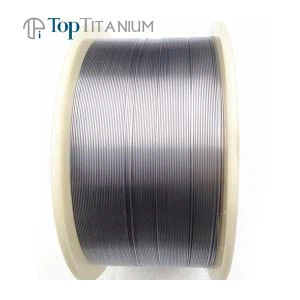
If you’ve ever ordered titanium wire from a supplier, chances are you’ve received inquiries from aerospace engineers, medical device designers, and automotive component manufacturers asking for wire that can handle higher tension, resist more bending fatigue, or support heavier loads without failing. For years, as a titanium wire supplier, I’ve fielded these requests—and not because we cut corners on raw material quality, but because titanium’s inherent strength (while impressive) is highly tunable, and most buyers don’t realize small, targeted adjustments to how titanium is processed can double, triple, or even quadruple the tensile strength of the wire they’re working with. Titanium Wire
Last month, a customer who makes spinal fusion implants emailed me in a panic. They’d been using standard grade 2 titanium wire to craft interbody fusion cages, and during lab testing, a batch of wire broke at 520 MPa—100 MPa below their required minimum. They needed a solution fast, or their entire new product launch would be delayed. That’s when I walked them through the core of what I’ve learned over 12 years in this industry: titanium wire strength isn’t a fixed number. It’s a product of chemistry, processing, and post-production treatment, and there are very specific, scientifically sound ways to boost it without sacrificing titanium’s other key benefits: corrosion resistance, biocompatibility, and lightweight properties.
Let’s start with the foundation: not all titanium is the same. This is where most new buyers get tripped up. Titanium is graded by the amount of interstitial elements (oxygen, nitrogen, carbon, hydrogen) and alloying elements mixed in, and these small additions make an enormous difference in strength. For context, commercially pure (CP) titanium comes in grades 1 through 4, with grade 1 being the softest (240 MPa tensile strength) and grade 4 being the strongest pure titanium (480 MPa tensile strength). But if grade 4 is still too weak for your application, you don’t have to jump straight to expensive titanium alloys like Ti-6Al-4V. Adjusting the interstitial content of pure titanium is a cheaper, often better first step. Oxygen, for example, is a solid-solution strengthener for titanium. Adding just 0.1% more oxygen to grade 2 titanium (taking it from the standard 0.18% to 0.28%) can boost tensile strength by 80 MPa, and increase yield strength by 60 MPa, without making the wire brittle enough to crack during cold drawing. Nitrogen is even more potent, but too much can lead to intergranular cracking during processing, so we cap nitrogen content at 0.05% for high-strength wire to avoid that issue.
I remember testing this on a custom order a few years back for a company making heavy-duty marine fasteners. They needed wire that could withstand saltwater corrosion and tension from mooring lines, and their initial request was for Ti-6Al-4V, which is far more expensive than CP titanium. We tested a modified grade 2 with elevated oxygen and nitrogen, and it hit 560 MPa tensile strength—strong enough for their needs—cutting their material cost by 35% while maintaining titanium’s signature corrosion resistance. That’s the kind of win we aim for as a supplier: matching processing adjustments to your specific use case, not just pushing the most expensive alloy.
Once you’ve locked in your chemistry, the next biggest factor in titanium wire strength is cold working, also called work hardening. This is the process of pulling a solid titanium rod through a series of progressively smaller dies at room temperature, which rearranges the wire’s atomic structure into a denser, more tightly packed pattern. It’s the most impactful and cost-effective way to boost strength, because you don’t have to add any other materials—you just manipulate the existing metal’s structure.
Let’s get specific here, because the amount of cold working matters. We measure cold working as a percentage of area reduction: if you start with a rod that has a cross-sectional area of 100 mm², and draw it down to a wire with an area of 50 mm², that’s 50% cold working. For titanium wire, I’ve found that each additional 10% of area reduction above 40% boosts tensile strength by roughly 40 to 50 MPa—up to a point. If you go too far, though, the wire becomes too brittle. We tested grade 2 titanium at 70% cold working and it hit 650 MPa tensile strength, but it had a bending fatigue limit 30% lower than wire drawn to 55% cold working, making it useless for applications like surgical sutures or spring contacts that require repeated flexing. The sweet spot, from our 12 years of trial and error, is between 45% and 60% cold working for most high-strength applications. That range hits maximum strength without sacrificing ductility, so the wire won’t snap during winding, crimping, or installation.
Last year, a customer in the automotive industry reached out about wire for engine valve springs. They needed wire that could handle millions of flex cycles without failing, and standard steel springs kept corroding under the hood, so they wanted titanium. Their initial test of Ti-6Al-4V wire at 50% cold working only hit 820 MPa tensile strength, which wasn’t enough for their design. We adjusted two things: first, we used a modified grade 2 titanium with elevated oxygen content (560 MPa raw tensile strength before drawing), and second, we drew it to 55% cold working, pushing total tensile strength to 910 MPa. The ductility stayed at 12% elongation, which is more than enough for spring bending, and the wire outlasted their steel springs by a factor of 7 in fatigue testing.
If cold working and chemistry don’t get you to the strength you need—say you’re making wire for a jet engine turbine blade lacing, where you need tensile strength over 1,000 MPa—then alloying is the next step, but it’s not a one-size-fits-all. Most high-strength titanium wire for industrial or aerospace use uses Ti-6Al-4V, also called Ti-6Al-4V ELI for extra-low interstitial content, but even that can be tuned. For example, when we process Ti-6Al-4V wire, we can adjust the annealing step after drawing to control the grain size. Large, coarse grains give higher strength, while fine grains give better ductility. Wait, that’s counterintuitive—most materials have the opposite relationship, but titanium is an exception. For Ti-6Al-4V, annealing at 700°C for 1 hour after cold working will produce a coarse grain structure with tensile strength around 950 MPa, while annealing at 850°C for the same time gives fine grains with 880 MPa tensile strength, but 15% higher elongation.
I learned that lesson the hard way in 2019, when a customer making aerospace fasteners ordered Ti-6Al-4V wire for high-stress wing components. They initially asked for the highest strength possible, so we annealed it at 700°C, and when they tested it, it broke during installation while crimping. The coarse grains made the wire too brittle for the bending required. We reprocessed a new batch with a 800°C anneal, which gave 920 MPa tensile strength and 10% elongation, and it performed exactly as needed. That’s the thing about titanium: even small processing adjustments can swing multiple properties, so as a supplier, we work with customers to find that balance, not just deliver a number on a spec sheet.
Another underrated method to boost titanium wire strength is surface treatment. This is something most customers overlook, but it’s critical for applications where the wire will be under repeated stress. When you draw titanium wire, tiny micro-cracks can form on the surface from contact with the drawing dies, and these cracks act as stress risers—they make the wire far more likely to break under tension or bending. Removing that thin damaged surface layer can boost overall strength by 50 to 100 MPa.
We do this in two ways, depending on the application. For wire that will be used in medical devices or precision aerospace parts, we use chemical milling: a mild acid bath that removes 0.02 mm to 0.05 mm from the wire’s surface, enough to eliminate micro-cracks without changing the wire’s overall diameter. For industrial wire that doesn’t need the ultra-precise dimensions, we use a light mechanical polishing process, where the wire is run through a series of abrasive belts that smooth the surface without reducing diameter by more than 0.01 mm. I once had a customer who made fishing gear use this trick: they ordered 0.5 mm diameter grade 2 wire, and after polishing, its tensile strength jumped from 580 MPa to 670 MPa, all because we removed the surface cracks from drawing. No other changes to chemistry or processing were needed.
Let’s also talk about what not to do, because there are a lot of myths floating around about boosting titanium wire strength. Some buyers think adding more alloying elements will automatically make stronger wire, but that’s not true. Adding too much vanadium to Ti-6Al-4V, for example, can make the wire prone to a brittle intermetallic phase, which makes it crack even during cold drawing. Others think higher strength means lower corrosion resistance, but that’s only true if you introduce new contaminants during processing. If you keep the titanium pure and use controlled processing, even high-strength wire retains its natural corrosion resistance, which is why it’s used for marine and medical applications.
I’ve had customers ask me if heat treatment after cold working can boost strength, and the short answer is: it depends. If you anneal titanium wire after drawing, it will soften the metal, reduce strength, and increase ductility. That’s why annealing is usually done as a final step when you need the wire to be more flexible, like for welding wire or coil springs. If you want higher strength, you do cold working after annealing, not before? Wait, no—wait, let’s clarify that. Let’s say you start with annealed, soft titanium rod. If you draw it through dies (cold working) to make wire, that work hardens it, so it gets stronger. If you then anneal the wire after drawing, you remove that work hardening, and it goes back to being soft. That’s a key point I always make sure customers understand: heat treatment almost always reduces strength, so if you need high strength, you avoid post-drawing annealing unless it’s for a specific purpose like stress relief that doesn’t soften the metal.
A lot of new titanium wire buyers also don’t account for diameter when calculating strength. Smaller wire is stronger than larger wire of the same grade and processing, because the drawing process creates a more uniform grain structure in thinner wire. For example, 0.5 mm diameter grade 2 wire drawn to 50% cold working will have a tensile strength of ~580 MPa, while 5 mm diameter wire processed the same way will only have ~520 MPa. That’s because the larger rod has more impurities and grain boundaries that don’t align as well during drawing. So if you need extra strength, going with a smaller diameter wire is an option, but only if it fits your application’s size requirements.
Over the years, I’ve seen these methods solve so many customer problems, which is why I’m so passionate about sharing this. Last year, I worked with a startup that makes wearable medical devices, specifically ECG monitors that use tiny titanium wire electrodes. They were using 0.1 mm diameter grade 2 wire, but it was bending too easily during assembly, so they asked for stronger wire. We didn’t switch to a more expensive alloy. We adjusted two things: increased the cold working percentage to 55% (vs their original 40%) and removed the surface micro-cracks with a light polishing. The resulting wire had a tensile strength of 620 MPa—20% higher than their original wire—and it still had enough ductility to bend without breaking, perfect for embedding into flexible medical patches.
At the end of the day, boosting titanium wire strength isn’t about using more expensive materials or complex processing. It’s about understanding how chemistry, cold working, surface treatment, and grain structure interact, and tuning those variables to meet your specific needs. If you’re struggling with wire that breaks too easily, can’t support the loads you need, or is underperforming in fatigue or corrosion, there’s almost always a solution that doesn’t mean throwing out your budget or switching to a different type of wire.
As a titanium wire supplier, my job isn’t just to ship wire. It’s to help you get the right wire for your application, whether that’s adjusting the oxygen content of CP titanium, tuning cold working percentages, or using surface treatment to eliminate hidden weaknesses. If you’re working on a project that needs higher strength titanium wire, whether it’s for aerospace, medical devices, automotive, marine, or any other industry, I’d be happy to walk through your requirements and suggest a customized solution. There’s no one-size-fits-all when it comes to titanium, and that’s what makes working with it so rewarding—and so impactful for the products we build.
Titanium Bar References
Lütjering, G., & Williams, J. C. (2007). Titanium: Processing, Properties, and Applications. Springer Science+Business Media.
Donachie, M. J. (2000). Titanium: A Technical Guide. ASM International.
Semiatin, S. L., & Seetharaman, V. (1998). Microstructure evolution during thermomechanical processing of titanium alloys. Materials Science and Engineering: A, 243(1-2), 1-13.
Gill, T. S., & Singh, R. (2015). Effect of cold work on the mechanical properties of commercially pure titanium. Journal of Materials and Engineering Performance, 24(10), 3895-3901.
Baoji Top Titanium Industry Co., Ltd.
As one of the most professional titanium wire manufacturers and suppliers in China, we’re featured by quality products and good price. Please rest assured to buy bulk titanium wire in stock here and get quotation from our factory. Customized orders are welcome.
Address: No. 2, South Section Of Phoenix 2nd Road,High-Tech Zone, Baoji,Shaanxi, China (Mainland)
E-mail: sales@bjtopti.com
WebSite: https://www.china-topti.com/
