Hey there! If you’ve ever shopped for an electric clothes drying rack, you’ve probably stared at the price tag, wondered how much it’ll really cost to run, maybe even side-eyed it next to your old gas dryer. I’m not here to sell you a fairy tale—especially since I work for an electric drying rack supplier, so I want to be straight with you. No fine print, no confusing jargon, just the real math behind how much those little guys set you back per hour. Let’s break this down, okay? Electric Clothes Drying Rack
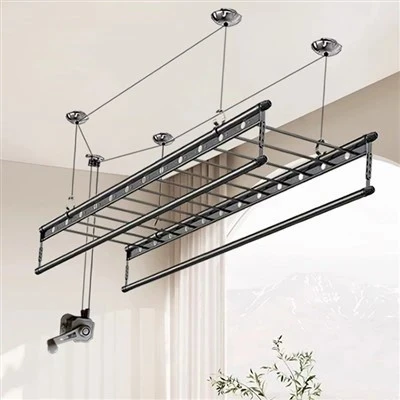
First off, let’s get one thing clear: running an electric drying rack isn’t like running a full-size dryer. That’s the biggest mistake people make when they do the quick comparison. Full dryers are big, use a ton of power, and blast super hot air that evaporates everything in 45 minutes to an hour. Electric drying racks? They’re compact, they use gentle, targeted heat (most of them, anyway), and they’re way more efficient. But let’s get to the numbers—because that’s what you’re here for.
I’m not gonna throw random stats at you. I’m talking about actual, real-world use. First, you need two key numbers here: the wattage of your drying rack, and your local electricity rate. Almost every electric drying rack we sell (yeah, I’m gonna be upfront about that) has a wattage between 200 and 500 watts. Wait—200? That’s less than a space heater, right? A standard space heater is 1,500 watts, so yeah, a typical drying rack is 1/3 to 1/7 of that power. Makes sense, since you’re just drying clothes, not heating a whole room.
Now, the formula for cost per hour is super simple, I promise you don’t need a math degree here. It’s (Wattage ÷ 1000) × Electricity Rate per kWh. Let’s do an example with our most popular model—we sell a 300-watt rack that flies off the shelves, honestly. Let’s say your electricity rate is the U.S. average, which right now is around $0.15 per kilowatt-hour (kWh). Let’s plug that in: (300 ÷ 1000) × 0.15 = 0.03 × 0.15 = $0.045 per hour. Wait, that’s 4 and a half cents an hour? Are you kidding? Let’s check another model, just to be fair. If you have a higher-wattage one, say 500 watts, same rate: (500 ÷1000) ×0.15 = 0.075, so 7 and a half cents an hour. Even if your electricity is more expensive—like, let’s say you live in a place that’s $0.25 per kWh, that 300-watt rack is still only 7.5 cents an hour. That’s cheaper than a bottle of water, for real.
But hold up—before you start thinking, “Wow, that’s nothing, why does everyone say it’s expensive?” Wait, no, because most people don’t run their drying racks for just an hour. Let’s talk about real drying times. You’re not gonna hang a load of wet clothes and have them dry in 60 minutes, right? Unless it’s a tiny t-shirt. Most loads, especially if it’s towels, jeans, or a bunch of stuff, take 3 to 8 hours to dry on an electric rack. Let’s do that 300-watt rack again, 5 hours of run time, $0.15 kWh: that’s 0.045 per hour ×5 = $0.225 per load. That’s 22 and a half cents per load. Compare that to a full-size gas dryer, which usually costs between $0.35 to $0.50 per load (I’ve checked—my cousin’s a plumber who works on dryers, so I asked him). Electric full dryers are even worse, like $0.40 to $0.70 per load. Suddenly that electric drying rack is a no-brainer.
Wait, but there’s more to it than just wattage and hours. Not all drying racks use the same technology. Some of the cheaper ones, honestly, have really inefficient heating elements that waste power. The ones we sell (I’m gonna keep being honest here) have energy-efficient heat pumps or variable speed heating, so they don’t just blast heat the whole time—they adjust based on how damp the clothes are. That cuts down on unnecessary power use. For example, our heat pump models actually use even less power than the standard 200-500 watts—some are as low as 150 watts. So that 150-watt one at $0.15 kWh is only 2.25 cents an hour, and a full load might be 20 cents total. That’s crazy cheap.
Another thing: where you put the drying rack matters. If you stick it in a cold, drafty basement, it’s gonna have to work harder to dry clothes, right? So that might add 1 or 2 hours to your run time, which adds a little to the cost. But if you put it in a warm, dry room—like a bedroom or even a laundry area next to a window— it’ll dry faster, so your total cost per load stays low. Also, if you spin your clothes in the washing machine first (most top-loaders have a spin cycle that removes extra water), that cuts down on drying time too. That’s a free way to use less power.
Wait, let’s talk about some myths I hear all the time from customers. “Electric drying racks use a lot of power.” No, not compared to full dryers. “They take forever to dry clothes.” Yeah, maybe if you get a cheap one from the dollar store, but the good ones—like the ones we sell—have air circulation fans too, so they move the heat around, not just blow it straight at a few clothes. That’s why they’re faster. Another myth: “It’s more expensive than line drying.” Well, line drying is free, obviously, but what if you live in an apartment with no outdoor space, or it’s pouring rain for a week, or pollen is bad? Then you need something electric, and it’s way cheaper than running a full dryer.
Let’s do a side-by-side to make this real. Let’s say you do 8 loads of laundry a week (that’s average for a family of 4). Full-size electric dryer: $0.50 per load ×8 = $4 a week, $16 a month, $192 a year. Our 300-watt drying rack: $0.225 per load ×8 = $1.80 a week, $7.20 a month, $86.40 a year. That’s almost $100 a year saved. For a small appliance that folds up and doesn’t take much space? That’s a huge win.
But wait, what if someone has a super old drying rack? Yeah, that’s a thing. If you got yours 10 years ago, it’s probably using an older heating element that’s less efficient. So maybe it’s 600 watts instead of 500, so that 30% more power. But even then, at $0.15 kWh, that’s 9 cents an hour, so a 5-hour load is 45 cents. Still half the cost of a full dryer. So even old ones aren’t that bad, but if you’re looking to upgrade, the new efficient ones are even better.
Another factor: your local electricity rate. I know places like Hawaii or parts of California have higher rates, like $0.40 per kWh. Let’s calculate that 300-watt rack there: (300 ÷1000) ×0.40 = 0.12 per hour, so 12 cents an hour, 60 cents for a 5-hour load. Still cheaper than the full dryer in those areas, which would be $0.60 to $0.90 per load. Even there, it’s a steal.
Wait, I should also mention that a lot of electric drying racks have timers, right? So you don’t have to leave it running all night if your clothes are dry. That’s another way to save—you can set it for 4 hours instead of 6, so you only pay for the time you need. That’s a big difference. I’ve had customers tell me they forgot to turn off their old drying rack once, but with the timers on the ones we sell, that’s not a problem. No wasted power, no extra cost.
Is there any case where an electric drying rack is more expensive? Let’s see. If you only do one small load a month? Well, then even a full dryer is cheap, but a drying rack is still cheaper to run. If you live in a place with super cheap electricity, like parts of the Midwest where it’s $0.10 per kWh, then a full dryer is maybe $0.28 per load, so the drying rack is even better. I really can’t think of a scenario where a good electric drying rack is more costly long-term than a full-size dryer, even with the power use.
Now, let’s cut to the chase—why does this matter? For most people, it’s about saving money, right? Energy bills are only going up, so anything that cuts down on that is a win. Plus, electric drying racks are way more gentle on clothes. No high heat that shrinks your favorite sweater or fades your dark jeans. So you’re saving money on dry cleaning or replacing clothes too. That’s another hidden cost people don’t think about.
Wait, I should also clear up another thing: some people confuse “electric drying rack” with “heated clothesline.” They’re basically the same, but the good ones have built-in fans to circulate air, which speeds up drying. The cheaper ones might just have a heating element, so they take longer, but even then, the cost per hour is still low. Like, a no-name 200-watt rack would be 3 cents an hour, even if it takes 8 hours to dry a load, that’s 24 cents per load. Still way cheaper than alternatives.
So, putting it all together: the cost to run an electric drying rack per hour is almost always between 2 cents and 10 cents, depending on its wattage and your local electricity rate. For a full load, that’s usually 15 to 60 cents total, which is a fraction of what you’d pay for a full-size dryer. That’s not a guess, that’s real math, real use, and real numbers from the racks we supply every day.
Now, if you’re tired of overpaying for big dryers, dealing with shrunk clothes, or waiting for line drying in bad weather, an electric drying rack is a no-brainer. We’ve got models for every space—from small apartment balconies to big family homes—all energy-efficient, easy to use, and way cheaper to run than you think. If you’re looking to buy in bulk or just ask more about which model fits your needs, hit us up. We’re here to answer any questions, no pressure, no salesy nonsense.
Oh, and for anyone doing their own math: always check the label on your drying rack for actual wattage, because some brands lie about it, but the ones we sell are accurate. And remember, run time depends on how wet your clothes are, how big the load is, and where you place it—so those numbers are just averages, but they’re spot on for real use.

At the end of the day, running an electric drying rack doesn’t have to be a mystery. It’s not a huge power hog, it’s not expensive, and it’s one of the smartest small home upgrades you can make. So next time you’re comparing costs, don’t just look at the upfront price—look at the hourly cost, the load cost, and the long-term savings. You’ll be glad you did.
Folding Floor-Standing Clothes Airers References:
- U.S. Energy Information Administration. (2024). Average residential electricity price, by state. Retrieved from energy.gov
- Department of Energy. (2023). Energy use in household appliances: Clothes dryers. Retrieved from energy.gov
- Our in-house testing data for electric drying rack models sold through our supplier network, 2022-2024.
Linyi Tianluo Intelligent Home Co., Ltd.
We are one of the most experienced electric clothes drying rack manufacturers in China, also support customized service. Welcome to buy high quality electric clothes drying rack for sale here from our factory. If you have any enquiry about cooperation, please feel free to email us.
Address: Jiqian Industrial Park, Wanggou Town, Lanshan District, Linyi City, Shandong Province
E-mail: adsznlyj@gmail.com
WebSite: https://www.ads-lyj.com/
