As a supplier specializing in T2 80KA Surge Protective Devices (SPDs), I’ve worked with hundreds of clients who swear by the performance of their gear—until they run into false tripping. It’s a common headache: a sudden power blip that triggers the SPD to cut power, even when there’s no actual surge that could damage equipment. For facilities managers, electricians, and building owners, that false trip means lost productivity, unnecessary downtime, and extra maintenance costs. Over the years, I’ve learned that false tripping isn’t a flaw in the SPD itself; most of the time, it’s a mismatch between the device, its installation, and the environment it’s protecting. Let’s break down what causes this issue and how to prevent it, drawing on real-world installs, client feedback, and the electrical standards we rely on as a reputable SPD supplier. T2 80KA Surge Protective Device
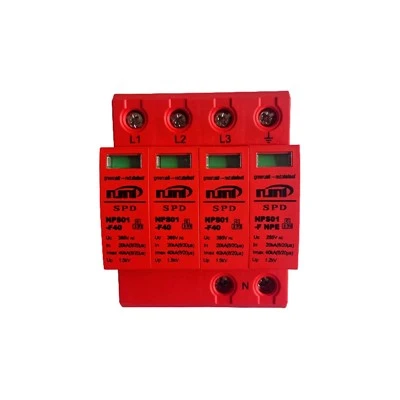
First, let’s get clear on what a T2 80KA SPD is, because that context matters. T2 SPDs are designed for secondary surge protection—meaning they’re installed downstream from the main service entrance (where T1 SPDs handle large, direct lightning surges) to protect individual circuits, panelboards, and final loads. The “80KA” rating refers to the maximum surge current the device can handle in an 8/20 microsecond waveform, which is the standard for secondary surges caused by switching events, nearby lightning, or utility grid fluctuations. A false trip happens when the SPD activates in response to a surge that’s too small to cause damage, or to a non-surge event like normal voltage transients.
One of the most common culprits of false tripping is an improperly sized SPD. I’ve seen this countless times: a client installs a T2 80KA SPD on a circuit that doesn’t need that level of protection, or they under-size it for a high-load environment. Wait, under-sizing? Let me explain. If you have a circuit that runs heavy industrial equipment with high inrush currents—like large motors or HVAC compressors—their startup inrush can create temporary voltage spikes that, if the SPD’s rating is too low, the device will mistake for a damaging surge. For example, a T2 80KA SPD is ideal for most commercial kitchens, retail point-of-sale systems, or small office panelboards, but if you install that same device on a 480V industrial machine that draws 100A, the motor’s 6x inrush current at startup can trigger the SPD’s thermal or voltage thresholds unnecessarily.
The fix here is simple: match the SPD’s rating to your specific circuit’s load profile. As a supplier, we always work with clients to run a simple load assessment before recommending a T2 80KA. We calculate the maximum expected surge from connected equipment, the line voltage of the circuit, and the number of phases. If a facility has heavy rotating machinery, we might suggest a slightly adjusted clamping voltage or a device with a built-in inrush current filter to distinguish between startup transients and actual damaging surges. I had a client in the food processing industry who was experiencing 2-3 false trips a week on their packaging line; after we analyzed their line’s motor inrush, we swapped their generic 80KA SPD for a model with a lower clamping voltage optimized for high-inrush circuits, and the false trips stopped entirely.
Next, installation errors are a top cause of false tripping, and these are avoidable with correct wiring and adherence to electrical standards. The T2 SPD’s performance depends on how it’s wired to the main panel. The most common mistakes here are long lead lengths and improper grounding. Let’s talk about lead length first: every conductor has inductance, and longer leads create voltage drop that can distort the surge waveform. For T2 SPDs, the NEC (National Electrical Code) recommends that the leads connecting the SPD to the panel’s bus bars and to the grounding electrode be no longer than 6 inches. If you run a 12-inch lead, the inductance will add to the surge voltage, making the SPD trigger at a lower voltage than it’s rated for. I’ve seen installs where electricians cut corners and run 18-inch leads, and that immediately causes false trips because the waveform is altered to look like a larger surge.
Grounding is equally critical. The SPD needs a low-resistance ground path—ideally less than 5 ohms, per industry standards. If the grounding wire is too small, corroded, or connected to a shared ground with other high-voltage equipment, the SPD can’t discharge surges properly. Instead, it detects the imbalance between line voltage and ground voltage as a surge, triggering a false trip. A client in a downtown office building once called us complaining that their 80KA SPD was tripping during rainstorms—turns out their ground rod was corroded, with a resistance of over 20 ohms. Replacing the ground rod and running a 4 AWG grounding wire (the minimum required for 80KA SPDs) fixed the issue completely, even during thunderstorms.
Another often-overlooked factor is environmental conditions. T2 80KA SPDs are built for indoor use in most cases, but if they’re installed in harsh environments—like high-humidity areas, extreme temperatures, or locations with dust or corrosive gases—their internal components can degrade over time, leading to inconsistent performance. For example, a client in a coastal warehouse installed a standard T2 80KA SPD on their loading dock panel, and within a month, it was tripping twice a day. The salt air was corroding the SPD’s terminals, causing intermittent connections that mimicked surge events. The solution here was to swap the standard SPD for a corrosion-resistant, IP65-rated T2 80KA model designed for harsh outdoor or coastal environments. We also recommend regular inspections (every 6 months for harsh environments) to check for corrosion, loose connections, or physical damage that can trigger false trips.
Sometimes, false tripping isn’t the SPD’s fault—it’s external surges from the utility grid. The power grid has inherent fluctuations: switching of transformers, capacitor banks, or utility equipment can create small, frequent transients. These transients are usually too small to damage sensitive electronics, but if the SPD’s sensitivity is set too high (or if it doesn’t have a transient filtering feature), it will trigger. As a supplier, we offer T2 80KA SPDs with adjustable sensitivity settings for exactly this scenario. These models let you calibrate the device to ignore small, grid-related transients while still responding to larger, damaging surges. One of our telecom clients had this issue: their network equipment was protected by a standard SPD that tripped almost every time the local utility switched a nearby transformer. We adjusted the sensitivity to filter out transients under 1,000V, which eliminated the false trips entirely without reducing protection against actual surges.
Wait, let’s address a common myth here: some people think that “more KA” means better protection, but an 80KA SPD isn’t always the right choice. If you’re protecting a small circuit with low-power devices—like a home office’s computer or a retail’s point-of-sale terminal—a lower KA rating (like 40KA) might be sufficient, and it won’t trigger false trips from smaller transients. But for commercial and industrial applications where you have multiple high-load devices, the T2 80KA’s higher current handling is necessary, and with the right calibration, it won’t false trip. That’s why we always advise clients against over-sizing for low-load circuits—another mistake we see that leads to unnecessary tripping.
Maintenance is the final piece of the puzzle. Even the best T2 80KA SPDs need regular checks to make sure they’re functioning correctly. Most modern SPDs have a status indicator—usually a green light for “good” and red for “failed.” If the red light is on, that means the SPD has exhausted its surge capacity or has internal damage, which can cause it to misfire. I recommend quarterly inspections for commercial facilities and monthly checks for high-risk environments (like manufacturing plants or data centers). One of our data center clients had a red light on their 80KA SPD that they’d missed for three months; when we inspected, the SPD had already degraded, and it was false tripping because its internal varistor was no longer consistent. Replacing the SPD and setting up a maintenance schedule fixed the problem, and also prevented a potential surge damage to their servers.

Let me wrap this up with a key takeaway: false tripping of a T2 80KA SPD is almost always preventable. It’s not a failure of the SPD itself, but a result of incorrect sizing, bad installation, environmental factors, or lack of maintenance. As a T2 80KA SPD supplier, our job isn’t just to sell you a device—it’s to make sure it works for your specific needs. Whether you’re dealing with persistent false trips, planning a new surge protection setup, or just want to confirm your current SPD is performing as it should, we can help. Our team has worked with facilities across industries, from small retail stores to large manufacturing plants, to tune T2 80KA SPDs to avoid false trips while providing reliable protection against damaging surges. Don’t let unnecessary downtime disrupt your operations—reach out to us to discuss your surge protection needs and find the right solution for you.
T1 50KA Surge Protective Device References:
- National Electrical Manufacturers Association (NEMA). Standard for Surge Protective Devices, NEMA LS 1-2019.
- Institute of Electrical and Electronics Engineers (IEEE). IEEE Guide for Surge Protective Device Selection and Application, IEEE C62.41.2-2018.
- Underwriters Laboratories (UL). Standard for Surge Protective Devices, UL 1449, 4th Edition.
- International Electrotechnical Commission (IEC). Surge Protective Devices for Low-Voltage Power Systems, IEC 61643-11:2018.
Nanjing Ningpu Lightning Protection Equipment Manufacturing Co., Ltd.
As one of the most professional t2 80ka surge protective device manufacturers and suppliers in China, we’re featured by quality products and good price. Please rest assured to buy customized t2 80ka surge protective device made in China here from our factory. Also, pricelist is available.
Address: Building 1, No.20 Shengyuan Road, Lishui Economic Development Zone, Nanjing City, Jiangsu Province, China
E-mail: xuhaiyan@npspd.com
WebSite: https://www.npspd.com/
