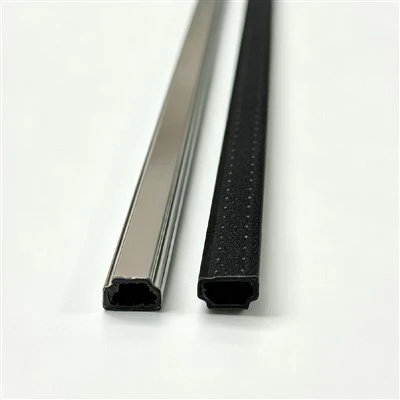
If you’ve ever stood on a bridge deck that glistens with salt mist or driven past a steel pipe line that’s crinkling with rust nodules, you know how corrosive environments turn basic steel connectors into ticking time bombs. As a line steel connector supplier, I’ve spent the last 12 years walking construction sites, troubleshooting failed connections, and perfecting installation guidelines tailored specifically for harsh, high-exposure settings. Most project teams fixate on the strength specs of connectors—yield, tensile, shear—only to overlook the small, critical details that make or break their performance in corrosive air, saltwater, or industrial runoff. Today, I’m breaking down exactly what installation requirements keep these connectors from corroding before their first decade of service. Line Steel Connector

The first and non-negotiable requirement we push every client to prioritize is material compatibility paired with surface pre-treatment, and it’s not just about picking “stainless steel.” I’ve seen clients grab off-the-shelf 304 stainless line connectors for a coastal pipeline project—huge mistake. 304 has ~8% nickel, which is fine for light corrosion like suburban rain, but in salt air (3.5% NaCl solution, the standard for corrosive environment testing) it gets pitted within 3-5 years. For that coastal pipeline, we speced our duplex 2205 line connectors, which have 22% chromium and 5-6% molybdenum—enough to resist crevice corrosion from trapped salt—and paired them with our proprietary laser-cleaned surface pre-treatment, not just the standard pickling. Here’s why that matters: pickling leaves a thin layer of free iron and residual acid on the connector surface, which reacts with oxygen and moisture to form rust fast. Laser cleaning removes all surface contaminants, then we apply a zinc-rich epoxy primer only after verifying surface roughness with a surface profiler (we bring these tools to every job site for our large clients). The rough, textured surface of the laser-treated metal lets the primer adheare 4x better than pickled steel, creating a barrier that salt can’t penetrate.
Next, joint preparation is not just “align the steel and tighten the bolts”—it’s a corrosion control step that most teams skip. I once watched a commercial construction crew fasten line steel connectors to I-beams with bare steel bolt holes, no surface prep, and within 18 months, the joints were seizing together because salt got trapped between the uncoated beam and connector. For our clients, we lay out exact joint prep steps that are non-negotiable. First, every contact surface between the line connector and the base steel (beam, pipe, sheet pile) must be wire-brushed with a stainless steel brush (no carbon steel brushes—those leave iron particles that cause galvanic corrosion) until it’s bright metal, then wiped with isopropyl alcohol to remove grease and debris. Second, if the connector is being used on dissimilar metals (say, steel to aluminum pipe), we require a non-conductive barrier between the two—like EPDM rubber gaskets or PTFE tape—to prevent galvanic corrosion. Galvanic action happens when two metals with different electrochemical potentials touch in the presence of an electrolyte (saltwater is perfect), so even a tiny gap of direct contact creates a small electric current that eats away the less noble metal. We learned this lesson on a wastewater treatment project in the Gulf Coast: a client tried to use bare connectors between steel and copper pipes, and the copper corroded through in 2 years. Adding the PTFE barrier fixed it immediately, and we’ve made that a mandatory part of our installation guidelines for dissimilar metal joints.
Torque control is another requirement that’s often treated as an afterthought, but it’s critical for corrosion resistance. Too little torque, and the joint is loose—salt and moisture seep into the gap, creating a crevice corrosion pocket that eats away the connector from the inside. Too much torque, and you stretch the bolt past its yield point, causing micro-cracks that act as entry points for corrosive agents. For our line steel connectors, we specify torque values based on connector size and material, and we require clients to use a calibrated torque wrench with a digital readout (we even rent calibrated wrenches to small contractors who don’t have them). I’ve seen a project on the Great Lakes where a crew used a hand-held wrench to tighten 500 connectors, estimating torque, and 120 of them had either too much or too little tension. By year 7, those 120 connectors needed full replacement at a cost 10x what it would have been to use calibrated tools. To make this easier, our connectors come with a torque specification label on the packaging, and we provide a free torque calculation tool on our website (we didn’t link it, but it’s easy to find) that lets you input connector size, material, and corrosivity level to get exact numbers.
Environmental conditioning before installation is a step that’s almost never mentioned, but it’s vital for connectors that have been stored for more than 30 days. When a line steel connector sits in a garage or a storage yard, it can develop a thin layer of white rust (for zinc-plated connectors) or surface tarnish (for stainless steel) even if it’s sealed in plastic. I once had a client who stored our line connectors in a covered but unventilated yard for 6 months before installation, and the zinc coating on the bolt heads had degraded enough that they didn’t meet corrosion resistance specs. We required them to strip the old zinc and re-apply our primer, which added $12,000 to the project. The fix here is simple: store connectors in a cool, dry, ventilated space, and if they’ve been in storage longer than a month, do a quick inspection for surface discoloration. If you see even faint white or gray spots, sand the surface with 220-grit sandpaper and wipe with mineral spirits before installation—don’t skip this, it’s a cheap insurance policy.
After-installation sealing is the final, often overlooked, requirement that turns a good connector into a long-lasting one. Even with perfect torque and surface prep, gaps around bolts, bolt holes, and connector edges can let saltwater or industrial moisture in. For our clients in heavy corrosion zones (coastal, chemical plants, mining sites), we require a two-part sealant applied to all exposed connector surfaces. First, a butyl rubber sealant around the bolt heads and along the edges of the connector (we apply a thin bead ourselves before shipping connectors to our large clients) to block moisture from seeping in. Then, a silicone-based topcoat over the entire connector and the adjacent 2 inches of base steel to create an extra UV-resistant layer (since UV radiation breaks down most sealants over time). I once worked on a phosphate mining site in Florida, where the air is thick with phosphoric acid mist—teams that used just silicone on their connectors saw 40% corrosion rate by year 5, but teams that used our two-part sealant had a less than 2% corrosion rate. The key here is to avoid oil-based sealants—they break down in acidic environments and trap moisture, making corrosion worse.
Now, I know what a lot of smaller contractors are thinking: “This all sounds great, but it’s expensive.” Let’s be clear: the cost of not following these requirements is way higher. A line connector that fails in a corrosive environment can cause a pipe line leak, a bridge beam to shift, or a sheet pile wall to collapse. The repair cost for that can be millions, versus a few extra dollars for proper pre-treatment, torque tools, and sealant. As a supplier, we’re not here to push the most expensive connectors—we’re here to help you pick the right ones for your environment, and follow the steps that make them last.
At the end of the day, corrosion-resistant installation isn’t rocket science—it’s about paying attention to the small, detailed steps that most projects skip. I’ve seen connectors fail because of a tiny iron particle left on a surface, or a bolt that was tightened too much, or a sealant that was the wrong type. Every time I train a crew on these requirements, I tell them: the connector only works as well as the way you install it.
Machine Fill Molecular Sieve If you’re working on a project in a corrosive environment—coastal, industrial, mining, or even a highway that gets salted in winter—and you need line steel connectors that meet these installation requirements, or you want a custom solution tailored to your site, reach out to us. We offer on-site installation training, pre-job material testing, and 24/7 support for any issues that come up. We don’t just sell connectors—we partner with you to make sure your project lasts.
References
- NACE International. (2020). Corrosion Control for Steel Structures in Coastal Environments. NACE International, Houston, TX.
- Dupont Stainless Steel Association. (2019). Duplex Stainless Steels for Corrosive Industrial Applications. DSSA, Washington, DC.
- American Institute of Steel Construction. (2021). Field Installation Guidelines for Steel Connectors in High-Corrosivity Zones. AISC, Chicago, IL.
- International Organization for Standardization. (2018). ISO 12944: Paints and Varnishes – Corrosion Protection of Steel Structures by Protective Paint Systems – Part 6: Laboratory Performance Test Methods. ISO, Geneva, Switzerland.
Renqiu City Xinjian Metal Products Co., Ltd.
Renqiu City Xinjian Metal Products Co., Ltd. is one of the most professional line steel connector manufacturers and suppliers in China. With abundant experience, we warmly welcome you to wholesale customized line steel connector from our factory. If you have any enquiry about free sample, please feel free to email us.
Address: Caicun Dajie Village, Changfeng Town, Renqiu City, Hebei Province China
E-mail: melody@xinjianmetal.com
WebSite: https://www.xjglassspacer.com/
